Dallas Brodie Is Right: The BC Conservative Digital Verification Fight Needs Answers
May 18, 2026 · iVoteOneBC research desk
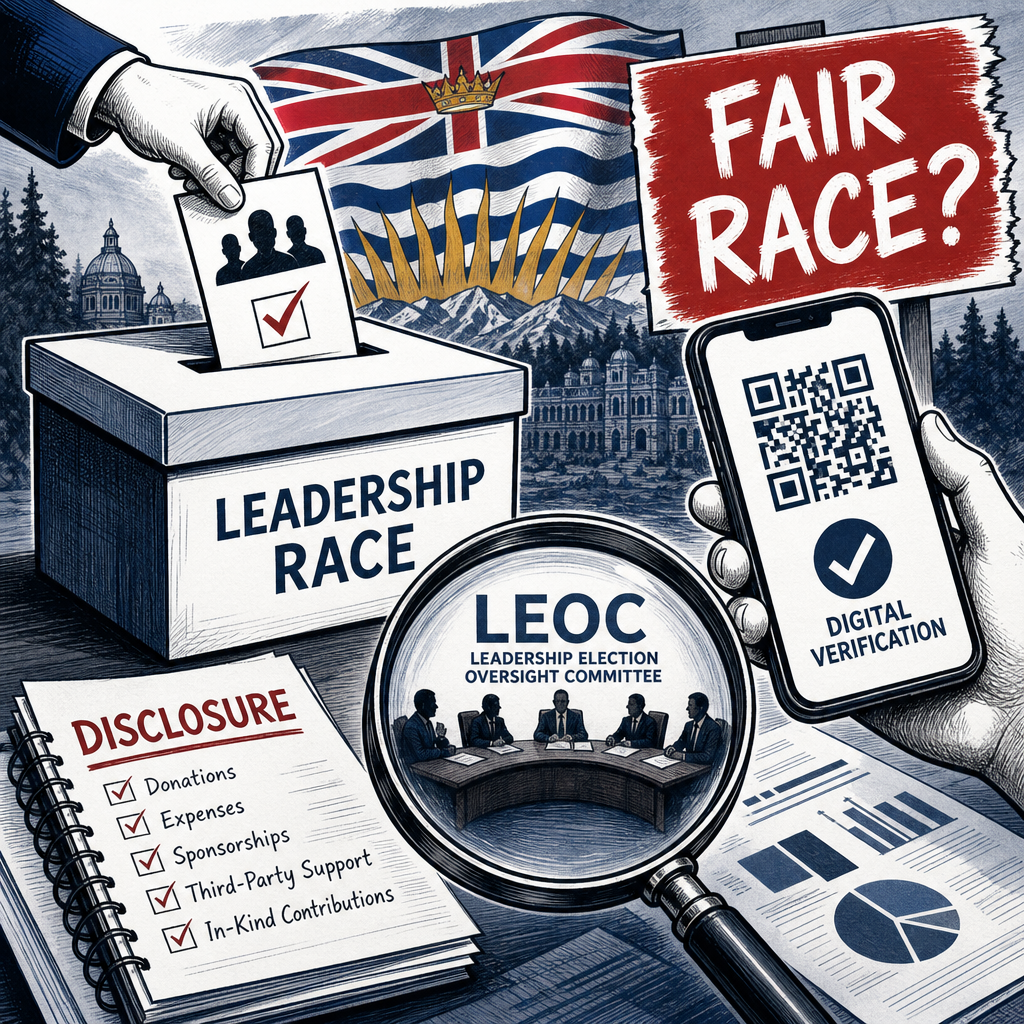
Dallas Brodie is right about the core issue: when a leadership race uses mandatory digital verification, and when online posts allege possible ties between election administrators and one campaign, the answer is not spin. The answer is disclosure.
The safe version of the story is this: screenshots circulating on X show Anthony Russo raising questions about the BC Conservative leadership race’s Leadership Election Organizing Committee, the use of Persona for digital verification, and alleged ties between some LEOC members and Caroline Elliott’s campaign network. Dallas Brodie reposted the concern and said it “needs to be looked into.”
We agree — with one important standard: allegations are not proof. Personal-relationship claims should not be treated as fact unless they are documented. But the public-record facts are enough to justify basic questions about transparency, recusal and voter confidence.
What checks out
The Conservative Party of BC publicly announced the Leadership Election Organizing Committee on January 2, 2026. The party described LEOC as an “impartial body” responsible for overseeing the race and administering the rules and procedures. The announcement also listed the committee members and non-voting participants.
The leadership rules go further: they say LEOC administers the leadership vote, handles compliance issues, can amend or waive rules, and must conduct itself in an “entirely neutral fashion” in all respects relating to the leadership vote.
The party’s leadership page also confirms that members must verify their identity to receive a ballot, that verification uses Persona, that the deadline is May 20 at 11:59 p.m. PT, and that online voting runs May 23 to May 29 using Simply Voting.
Without Diminishment’s own public “About” page also says Dr. Caroline Elliott is a co-founder and that she is “on leave while campaigning for the leadership of the Conservative Party of British Columbia.” That confirms one part of the X thread: Elliott’s connection to Without Diminishment is real and public.
What has not been independently proven
The more serious claims in the screenshots — alleged marital relationships, alleged staff ties, alleged past paid work, and alleged friendship links — require documents, named sourcing or on-the-record confirmation before anyone should state them as fact.
That does not make the questions illegitimate. It means the proper demand is not “convict people online.” The proper demand is: publish the conflict policy, publish the disclosure process, identify any recusals, and explain who approved the verification system.
The questions LEOC should answer
- Did every LEOC member file a conflict-of-interest disclosure for the leadership race?
- Were any disclosures made involving candidates, campaign staff, vendors or campaign-aligned media projects?
- Did any LEOC member recuse from decisions involving Persona, voter verification, complaints, voting rules or candidate disputes?
- Who specifically recommended and approved Persona?
- Was any alternative to digital verification offered for members uncomfortable with digital ID-style checks?
- How will the party prove that verification failures or voter drop-off did not advantage or disadvantage any campaign?
Why Dallas’s point lands
Brodie’s post connects two issues that grassroots conservatives already care about: fair internal democracy and digital ID. Yuri Fulmer has made opposition to mandatory digital ID part of his broader freedom pitch. Juno News reported in March that Fulmer vowed to prohibit mandatory digital ID for provincial services if elected premier, framing it as part of his proposed “B.C. Freedom Charter.”
That makes the optics of this leadership race especially combustible. If a major share of conservative voters distrusts digital ID, then mandatory online verification is not a neutral technical detail. It is a political trust problem. Even if Persona is secure and even if LEOC acted properly, the party should be able to explain why the system was chosen and how voters who distrust digital verification were protected from being chilled out of the process.
Update: even critics outside OneBC are now calling it a competence problem
A new BetterBC / QueerGrandDad post circulating on Facebook is titled “The Party That Can’t Run Its Own Election — The Gift the BC Conservatives Wrapped for the NDP.” The post is openly hostile to the BC Conservatives, so it should not be treated as neutral evidence. But it matters because it shows the verification controversy has moved beyond one campaign’s complaint and into the broader public narrative around competence.
The Facebook post’s preview says the BC Conservatives chose “a San Francisco company with a troubled security record” to verify leadership voters. That part needs careful wording. The official BC Conservative verification guide confirms Persona is the vendor and that members must use government-issued ID through a Persona-powered page before the May 20, 2026 deadline. The Tyee has also reported that Persona Identities Inc. is based in San Francisco and quoted a South Surrey party member who said he would not vote because he objected to providing identity documents to a U.S. company.
On the security-record question, the strongest sourced version is this: Malwarebytes reported in February 2026 that researchers said they found an exposed Persona front-end with 2,456 accessible files. Malwarebytes also published Persona’s later clarification that the exposed test environment was isolated from production, no personal data was exposed, no customer uses all possible checks, and Persona says customers control data handling and deletion. That does not prove BC Conservative member data is unsafe. It does prove the vendor choice deserves a plain-language privacy explanation before members are forced through the process.
The NDP gift angle
The BetterBC framing is partisan, but politically obvious: if the BC Conservatives cannot clearly explain their own leadership voting system, the NDP gets an easy attack line about competence. That is why the answer should be disclosure, not defensiveness: publish the vendor due-diligence memo, privacy/data-retention terms, fallback options for members without digital trust, verification failure numbers, and the location list for in-person assistance.
The bottom line
The strongest case here is not that the race is “rigged.” That has not been proven. The strongest case is that the race deserves sunlight before voting begins.
If LEOC is neutral, show the disclosures. If conflicts were reviewed, show the process. If recusals happened, say so. If no recusals were needed, explain why. And if digital verification is mandatory, prove that members who oppose digital ID were not effectively pushed away from the ballot box.
Dallas Brodie is right: this needs to be looked into. A fair race should not have to ask voters to take the process on faith.