Forced Dues, Political Classrooms: The BCTF Question Dallas Brodie Put on the Table
May 20, 2026 · iVoteOneBC research desk
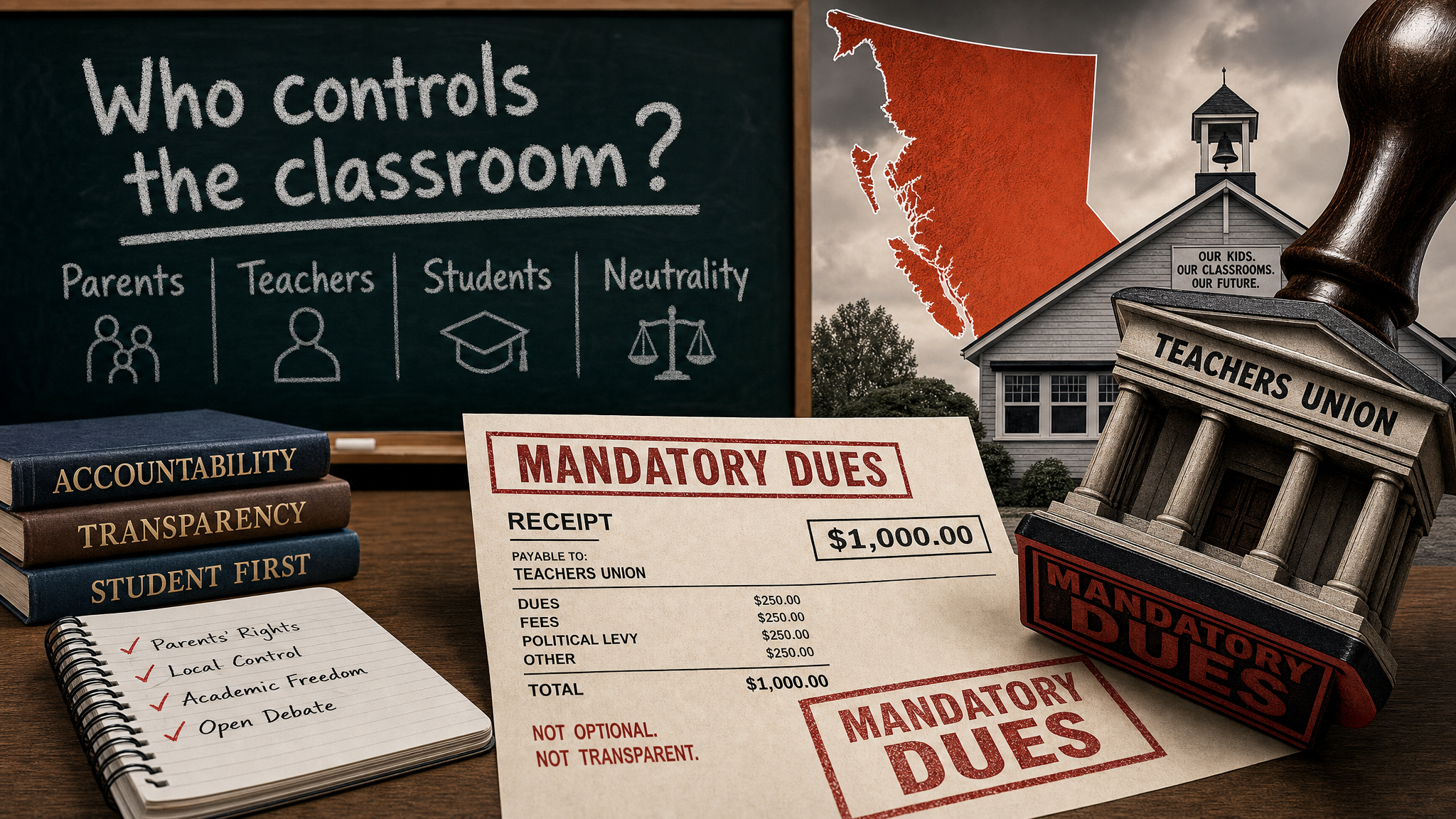
The issue is not whether students should learn Canadian history. The issue is whether teachers should be compelled to fund a union that mixes representation, politics and classroom ideology — while parents are told to trust the system.
Dallas Brodie has put a live wire into the B.C. education debate: membership in the British Columbia Teachers’ Federation should not be mandatory.
The post that triggered the discussion pointed to BCTF’s Teacher magazine and a classroom resource called The Truth in Truth and Reconciliation Educational Board Game. Brodie’s language was blunt, political and designed for Facebook. But beneath the social-media punch is a serious public-policy issue that deserves more than a shrug from Victoria.
The issue is not whether students should learn about Canadian history, residential schools, Indigenous rights or reconciliation. They should learn history honestly. The issue is whether a public-sector union that teachers are required to belong to should also function as a political and ideological force inside the education system — and whether parents and teachers have any meaningful choice when that line blurs.
Mandatory union membership changes the accountability standard. If teachers have no practical choice but to belong, then the union’s political and classroom-facing activity deserves public scrutiny.
British Columbia’s provincial teachers’ agreement does not treat BCTF membership as a casual optional association. The provincial collective agreement includes a membership requirement stating that employees covered by the agreement must become and remain members of the local teachers’ association and the BCTF.
That is the foundation of the debate. A private advocacy group can publish almost anything it wants. But when a union is embedded in the public education system and membership is required through the labour framework, the public has a right to ask whether that union is staying focused on core workplace representation — or using compulsory membership power to push broader politics.
The BCTF magazine item does not need to be caricatured. The resource exists. It is presented as an educational board game connected to truth and reconciliation. The creator’s write-up describes the project as a classroom resource and thanks BCTF’s Aboriginal Education office for support and an opportunity to publish the article.
There are teachers and parents who will see that as useful, respectful learning. Others will see it as part of a broader shift in which political frameworks increasingly move from teacher professional development into classroom expectations. The democratic question is not whether one resource is evil or virtuous. The question is who decides, how parents are informed, and whether dissenting teachers can object without being treated as enemies of progress.
That is where OneBC can own the lane. It does not need to mock Indigenous people, reconciliation or history. It can ask a cleaner and stronger question: who controls the classroom — parents, teachers and locally accountable schools, or a politicized union-government ecosystem?
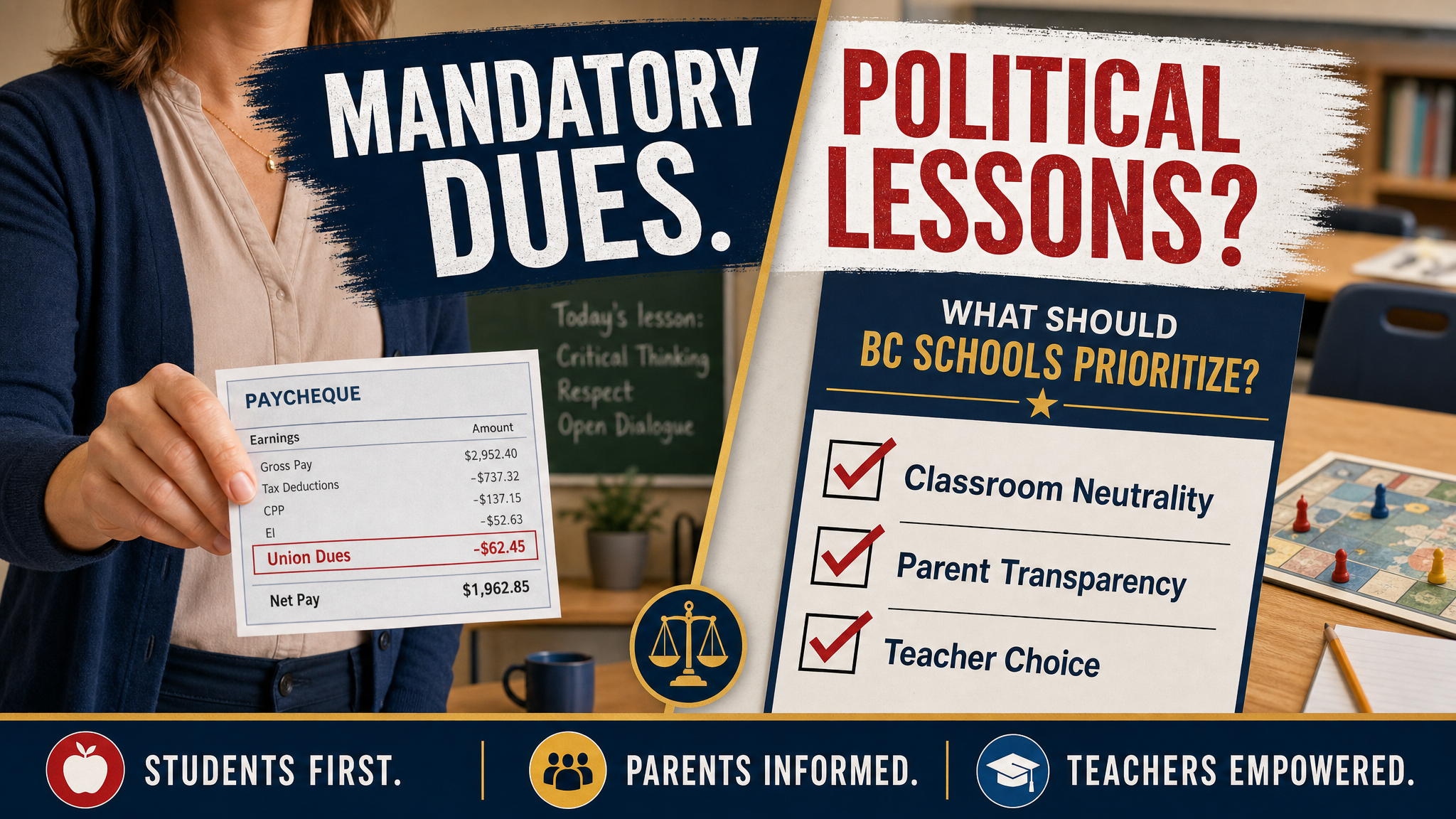
BCTF is entitled to political opinions. It regularly speaks on government policy, labour issues, Indigenous education, climate, equity, public funding and broader social questions. It has also participated in joint political advocacy with other unions and community groups.
But that is exactly why mandatory membership matters. The more a union acts like a political actor, the harder it is to pretend every teacher’s compulsory association is merely administrative. Some teachers will agree with BCTF’s direction. Some will disagree. Many will stay quiet because schools are workplaces, not Twitter threads, and most teachers simply want to teach.
A healthy democracy should protect those teachers too. Teacher professionalism should not require political conformity. Classroom neutrality should not be a dirty phrase. Parent transparency should not be treated as extremism.
Public-sector unions are a major force in B.C. politics, and the NDP’s governing coalition depends heavily on union-aligned support. That does not mean every BCTF action is directed by David Eby or the NDP. It would be unfair to claim that without evidence.
But it is fair to say this: when a powerful public-sector union pushes political and ideological priorities inside a public system run by an NDP government, voters are allowed to ask whether the classroom is being governed for students and families — or managed as part of a broader political project.
That is why Brodie’s post is landing. Parents are already anxious about curriculum, ideology, declining standards, classroom disorder, and whether their concerns are dismissed as backward before they are even heard. Teachers are anxious too: workload, safety, shortages, burnout and whether professional independence is being crowded out by politics.
Questions BCTF and the province should answer
- Why should BCTF membership be mandatory for all covered public-school teachers?
- What political or ideological advocacy is funded directly or indirectly by compulsory membership structures?
- Can teachers object to union political messaging without professional consequences or workplace pressure?
- How are parents notified when classroom materials involve politically contested frameworks?
- Does the Ministry of Education track how union-published classroom resources enter schools?
- Where is the line between teaching history and promoting ideology?
- Would the province support a transparent opt-out or choice model for teachers who want workplace representation without political association?
The strongest argument here is not anger. It is fairness.
Teachers should be free to teach without being forced into political conformity. Parents should know what ideological materials are being used in classrooms. Students should learn history, civics and critical thinking without being pushed into one approved political worldview. And unions that benefit from mandatory membership should expect scrutiny when they move beyond wages and working conditions into politics and classroom content.
That is a powerful education message for OneBC because it reaches beyond party labels. It speaks to parents, grandparents, teachers, taxpayers and new Canadians who came to B.C. expecting schools to focus on literacy, numeracy, discipline, respect, practical skills and honest history — not political capture.
Bottom line: If BCTF wants to operate as a political and ideological force, it should not be surprised when British Columbians question mandatory membership. Public schools belong to families and students first. Not unions. Not parties. Not activists. Not bureaucracies.
- Dallas Brodie Facebook post reviewed May 20, 2026: public Facebook video/post link.
- BCTF Teacher magazine, March 2026, “The truth in Truth and Reconciliation educational board game”: BCTF article.
- B.C. Provincial Collective Agreement, 2022–2025, membership requirement and union provisions: BCPSEA agreement PDF.
- BCTF news and advocacy archive reviewed May 20, 2026: BCTF news.
This article does not argue against teaching Canadian history or Indigenous history. It addresses mandatory union membership, political advocacy, classroom neutrality, teacher choice and parental transparency.