The Cowichan Warning: When Aboriginal Title Meets Private Property, Who Protects B.C. Homeowners?
May 21, 2026 · iVoteOneBC research desk
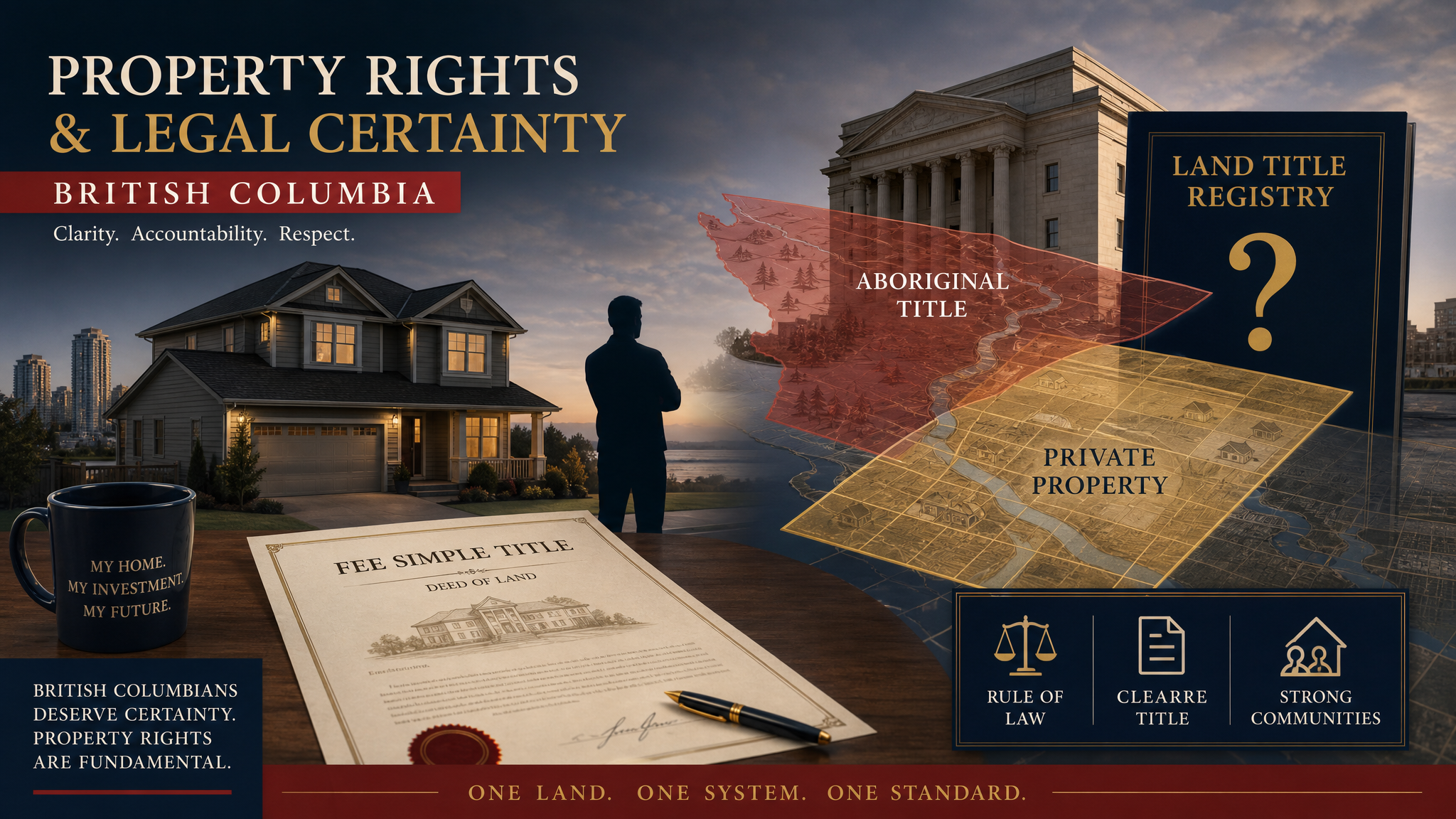
The issue is not Indigenous people versus homeowners. The issue is whether B.C.’s government can guarantee clear title, mortgage certainty, municipal authority and property rights when Aboriginal title is declared over land that includes privately held interests.
Odessa Orlewicz’s video uses language we will not use here. The serious public issue underneath it does not need inflammatory labels.
The real issue is the Cowichan Aboriginal title decision and what it may mean for private property, municipal government, mortgages, title insurance, land-use planning and B.C.’s already fragile trust in government. If Aboriginal title can be declared over land that includes fee simple interests, British Columbians deserve clear answers before another court ruling, treaty negotiation or DRIPA-driven policy shift changes the ground beneath their homes.
This is not Indigenous people versus homeowners. That frame is wrong and destructive. Indigenous peoples have real constitutional rights. Homeowners have real property expectations. Municipalities have real obligations to tax, regulate and service land. The province has a duty to reconcile all of those interests without leaving families, lenders, cities and taxpayers in legal fog.
Property rights are not a fringe issue. They are the foundation of mortgages, retirement savings, municipal tax bases, small business lending, family stability and investment confidence.
The B.C. Supreme Court’s decision in Cowichan Tribes v. Canada followed a massive trial and declared Aboriginal title over lands connected to the Cowichan’s traditional village site in what is now south Richmond. Legal firm Cassels summarized the decision as holding that Aboriginal title is a senior interest to fee simple, that B.C.’s land title system does not shield fee simple estates from Aboriginal title claims, and that the court found some historic Crown grants unjustifiably infringed Aboriginal title.
Other legal analysis is more cautious. Torys notes that the court did not declare third-party private fee simple interests invalid, but did leave uncertainty because the Crown must negotiate reconciliation of those fee simple interests with Aboriginal title. That distinction matters. It means homeowners should not be told “your house is gone.” But it also means politicians should not pretend nothing changed.
The correct word is uncertainty. And uncertainty is costly.
UBCM reported in March 2026 that the Cowichan appeal is in early stages and that all seven parties from the original proceedings appealed: the Province of B.C., the Government of Canada, the City of Richmond, Vancouver Fraser Port Authority, Musqueam Indian Band, Tsawwassen First Nation and the plaintiff group. UBCM also said it is seeking intervenor status so the Court of Appeal understands implications for local government’s ability to regulate, tax and service land.
That is not panic. That is local government saying the ruling has practical consequences. Cities do not run on theory. They run on property rolls, permits, utilities, roads, emergency services and tax bills. If the legal foundation of land interests changes, the municipal system needs clarity.

British Columbians need plain answers from Premier David Eby, the provincial government, and every party claiming to defend property rights:
- If Aboriginal title and fee simple can coexist, what exactly can each title holder do?
- Can a homeowner sell, refinance, renovate or insure property normally inside a recognized title area?
- Will banks treat property in contested or recognized Aboriginal title areas differently?
- Who compensates if a court or negotiation affects private use, development potential or market value?
- Can municipalities tax and regulate the same land in the same way?
- How does DRIPA affect the province’s negotiating position when private property is involved?
- Will the province guarantee homeowners against losses caused by Crown failures, historic grants or modern reconciliation agreements?
- Will B.C. publish a province-wide map of active title claims, litigation risks and private-property exposure?
Those questions are not anti-Indigenous. They are pro-certainty. A fair society does not make families guess whether the deed they paid for means what they were told it means.
OneBC’s lane is clear: property rights, legal certainty and public consent. Dallas Brodie has already made property rights and DRIPA accountability central to the movement’s message. The Cowichan appeal gives that message a concrete test.
The right policy is not denial. It is disclosure and guarantees. B.C. should publish the legal exposure, explain how it will protect existing homeowners, and stop pretending DRIPA is just symbolic language with no practical impact. If reconciliation requires negotiation, then homeowners should not be the silent third party left outside the room.
That means any provincial response should include:
- A homeowner protection guarantee for existing private owners affected by Aboriginal title litigation or settlement.
- Full disclosure of Crown liability and potential compensation exposure.
- Clear rules for mortgages, title insurance, renovations, permits and resale in affected areas.
- Mandatory notice to municipalities and owners where title litigation may affect private land.
- A DRIPA impact review explaining how provincial law and consent-based policy interact with fee simple title.
- A public commitment that ordinary homeowners will not be financially sacrificed for Crown mistakes made generations ago.
The NDP government asks British Columbians to trust it on DRIPA, land acknowledgements, consent agreements, title claims, housing supply and reconciliation. But trust requires clarity. When legal experts disagree about what a ruling means, the government’s job is not to manage optics. It is to protect the public.
British Columbians can support reconciliation and still demand that property rights be defined. They can respect Indigenous title and still ask who pays when Crown grants, municipal systems and private ownership collide. They can want justice for historic wrongs and still reject a system where families only learn the risk after buying a home.
The Cowichan appeal may take years. That is exactly why the debate must happen now, before uncertainty spreads across lending, development, municipal taxation and public confidence.
Bottom line: B.C. needs reconciliation with receipts, not uncertainty by press release. If private title is secure, prove it. If it is not, protect homeowners before the damage lands.
- Cassels legal analysis of Cowichan Tribes v. Canada: Aboriginal title and fee simple uncertainty.
- UBCM, March 11, 2026: UBCM seeks intervenor status in Cowichan Tribes appeal.
- Torys legal analysis, January 2026: Can Aboriginal title be declared in respect of privately-held lands?.
- Odessa Orlewicz Facebook reel reviewed as public lead, May 21, 2026: source video.
This article does not attack Indigenous people or deny Aboriginal rights. It focuses on legal certainty, homeowner protection, municipal authority, DRIPA accountability and property-rights policy.